
It’s been about two weeks I read this piece by Anglican priest Tish Harrison Warren on Christianity Today, which sparked a heated, yet necessary, conversation on Twitter.
Tish’s argument can be summarized with this statement:
“The broader church has a responsibility to provide formal support and accountability to teachers, leaders, and writers—whether male or female. If we don’t respond to this current crisis of authority institutionally, we are allowing Christian doctrine to be highjacked by whomever has the loudest voice or biggest platform.”
Twitter had already provided the stage earlier with #ThingsOnlyChristianWomenHear, which then turned into #ThingsOnlyBlackChristianWomenHear. The article also prompted #AmplifyWomen.
There have been such good dialogue, in particular, this one by a really good friend of mine and this one by Ann Voskamp.
Well, the blogosphere isn’t one church, with one globally agreed on doctrine, the blogosphere isn’t a pulpit with one espoused theology, and it isn’t a hospital where one goes when desperately needing surgery —- the blogosphere is a library.
The blogosphere is a library of storytellers, and while I may — and definitely do — profoundly disagree with other voices in the blogosphere — the point is:
We don’t censor a library, we learn how to venture through the library.
-Ann Voskamp

In church, I was seated.
Waiting for communion
to be distributed.
The mind set on
things I wish I could have muted.
What I read in these threads disturbed me because a lot of it sounds exactly like the voices emerging from the political arena these days.
But I admit, it also challenged me to get closer to Jesus.
Last Saturday night, I went to church and it was communion weekend. Something astounding happened as the ushers were distributing the communion elements. I must confess, my focus wasn’t on Jesus or my eternal gratitude for salvation, but I was looking to see if there were any women allowed to join the ushers to pass the elements. It was such a revelation of my heart at that moment and I could hear God gently whisper in my ear,
“you are more concerned with who’s distributing it,
but look around and see who’s receiving it.”
It was such a wake up call.
I felt the Spirit nudge me to read more of God’s words and less of everyone else’s.
We all experience God and church very differently because our experiences aren’t always the same. God speaks to our hearts precisely to what it is we need to hear. Kenny and I could go to the same church service but focus our attention in different parts of the sermon, which propels us to take a different course of action. Just like I can listen to a recording from the sermon I heard last weekend to receive something different from the last time I listened to it at church.
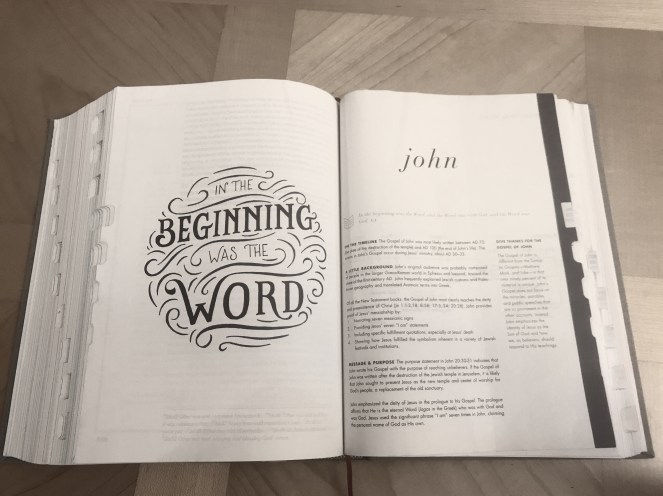
So instead of reading someone else’s opinion or interpretation, I decided to go back to the basics and re-read the Book of John.
Every new believer is encouraged to start with this book of the Bible. It is written by Jesus’ best friend and unlike the other Gospels, this one contains a relational tone because of its sole purpose to strengthen one’s belief, so that “you may believe that Jesus is the Messiah, the Son of God, and that by believing you may have life in his name.” (John 20:31)
I must admit, I don’t have the answer nor the solution to all our concerns. But I do know one thing:
We need to speak and write TRUTH without forsaking His SPIRIT, His GRACE, or His LOVE.
In Grace and In Truth
“The Word became flesh and dwelt among us. We observed his glory, the glory as the one and only Son from the Father, full of grace and truth.“
-John 1:14, CSB
Jesus is the Word (Logos).
From the beginning, He was with God because He IS God.
And He always seems to have the last word in every story.
Yet, even while having the last word, He maintains to keep truth cloaked in grace. Grace is listed before truth in John 1:14, but we are quick to make our statements without a smidgen of it.
Are we able to have a conversation full of grace and full of truth? It feels as of late we only want either full grace or full truth. We shouldn’t vilify each other’s characters simply because we disagree with our theological positions. Women who agree with a complementarian theology should not be made feel ignorant or “not woman” enough because they don’t hold an egalitarian view. As a woman who holds such a “patriarchal” view, I often feel left out of the conversation and it is inferred I am part of the problem.
I’d be lying if I didn’t admit I struggled with my supportive role. I am called to respect my husband as he is called to love me. Sometimes there are words he says and deeds he does which don’t reflect his love for me, so in return I don’t respect him. Additionally, there have been times I don’t show him respect, so in exchange, he doesn’t express his love for me as he should.
We rely on the other to change their attitudes in order for us to change how we treat them in response.
However, someone must break this twisted cycle, so who’s it going to be?
I’m testifying to my own experience; therefore, I understand this isn’t the case for every marriage. Within my role to support my husband, he has led me in humility while I submit to him in love. Submission isn’t a favorable word in societal terms; however, it’s been awfully misconstrued and at times, men have used it to mislead us. Frankly, many have caused us to feel insignificant and voiceless in our role and our purpose as Christian women.
When we feel misled, we feel like we must lead at all times.
But, men are not the true leaders; they must also submit to God, as they are commanded to LOVE US like Jesus LOVES THE CHURCH. Therefore, if they are not in the Spirit, then this formula won’t work, right?
It is apparent by these conversations that it hasn’t been working for awhile.
And therein lies the problem…
The problem isn’t what we can or can’t do in leadership or whether we have the authority to preach, teach, lead, and disciple men. It isn’t a competition.
That’s just a symptom.
The root of the problem is this: as women, we don’t feel protected nor empowered, and consequently, we lack trust in our leaders because we have felt they have betrayed it.
But let us not be distracted, we still contain ONE message and ONE mission, the same ONE John the Baptist had,
“I am a voice of one crying out in the wilderness: Make straight the way of the Lord.”
-John 1:23, CSB
We all have voices and we must use them to deliver a message of HOPE, not of doom.
I concur, despite our differing view in our roles, we shouldn’t be silenced.
And it isn’t that we shouldn’t be having these conversations. In fact, I think we need to now more than ever, BUT we have to be careful these conversations aren’t consuming us to the extremity of replacing our worship for Him. We praise and serve Jesus for who He is, not for what others say or do towards us. And as an act of worship to Him, we must make GRACE a colossal part of our message.
In Spirit and In Truth
I stumbled across John 4, where we are introduced to the first missionary woman. In order to understand who she is, we must first capture who she isn’t.
She isn’t a scholar. She isn’t polished. She isn’t revolutionary. She isn’t extraordinary.
She’s just in hiding. It must be exhausting for her to plan her day around what everyone else is doing, since she cares way too much about what they think. She didn’t have Twitter or Facebook as an outlet to defer her wrongs with pictures of her puppies, or defend herself while attacking her accusers. She hides from those who gossip, so she goes to the well at a time that it’s too hot for the other women to draw water. In silence. At noon.
She’s there to fill her jar with as much water as there is shame and guilt within her.
But she didn’t realize she had a divine appointment with living water Himself.
She’s a Samaritan and she’s also an adulteress. In the eyes of the educated and ordained, her message isn’t valid enough. Nevertheless, He will not let her voice be silenced because she will have a powerful message to give for those who choose to hear.
But first things first.
Jesus HAD to go through Samaria on his way to Galilee from Judea. He didn’t want to, like we don’t want to go to the bathroom. We HAVE to go. We sense this urge and we just automatically go; unless you’re a toddler attempting to potty train, you can’t miss the toilet– so Jesus couldn’t miss Samaria. Get it?
(Potty training is a serious and current topic in the Velsor household and in actuality, an upcoming event I’ve been dreading since Joshie was born…)
Anyway…
Jesus didn’t care for the rules and the social norms as much as he cared for the soul standing in front of him. He doesn’t introduce himself, he just goes for it and asks for water. She states the obvious, how is a Jew speaking to me, a Samaritan woman? (Traditionally, Jewish men were not to be conversing with women, let alone a Samaritan and an adulteress). Nevertheless, she’s intrigued by this living water Jesus is promising. The water she draws from this particular well is no longer satisfying her thirst.
Jesus asks her to call her husband. He knew the answer, but He isn’t afraid to go after a part of her heart she fights to keep hidden.
He isn’t afraid to go after the darkest and uninhabitable parts of OUR hearts we keep secret.
As soon as she realizes He’s a prophet, she attempts to pivot to politics. She doesn’t want to get any more personal than this. And dear friends, we do this. We go to politics because it is the trendy thing to do, it is what everyone else is talking about. We avoid getting personal. But nowadays, we use politics as a weapon to attack the other person. Not to say that politics isn’t important, but it isn’t Jesus.
Politics won’t save us;
the Laws of the land don’t save the soul.
Hence, Jesus should be at the core of our world.
He is the only One who saves.
Let’s not replace the power of His Spirit with opinions about political affairs or church positions.
His kindness and compassion must permeate our hearts when we talk about healthcare, immigration, abortion, economics, foreign affairs, gender and sexuality issues, and so on. Sometimes we take sides on issues as detached bodies to those who are deeply affected by them. Like the Pharisees, we stop caring for the soul standing in front us and instead pivot to the issues alone.
We can protest the government does or doesn’t do enough for its people, but are we as individuals and believers proactive with our deeds as we are with our words?
Are you generous with them when you expect others to be generous with you?
Are you appreciative of others when you expect others to appreciate you?
Are you kind to the unlovable when you expect kindness from others?
Are you compassionate to those who hurt when you expect compassion as you are hurting?
To be honest, I can keep going… but…
It isn’t about the what we believe, but the why we believe what we believe.
We can believe in Jesus because He is the Master of miracles, healing, and thirst-quenching, but He knew people were after the signs and not His heart (John 4:48).
We must steer clear from the self-serving Gospel of receiving Jesus only for what we can receive from Him first.
“God is spirit, and those who worship him must worship in spirit and in truth.”
-John 2:24, CSB
Jesus uttered these words to her, this is how God the Father desires all of us to worship. He didn’t have to do anything to prove to her His identity, but demonstrate His grace towards her and she instantly believed. He didn’t have to explain the complexities of the law or the plethora of existing theologies to depict God, He offered the one thing she was craving.
Living water.
The disciples couldn’t believe what Jesus just did, but unlike the Pharisees, they wouldn’t express their objections out loud. They had brought him food, but Jesus wasn’t hungry. Jesus had one mission, “My food is to do the will of him who sent me and to finish his work.” (John 4:34)
Jesus admonished his own disciples to open their eyes because they are missing out on the reaping of the Gospel.
I sent you to reap what you didn’t labor for; others have labored, and you have benefited from their labor.
-John 4:38, CSB
*Ouch*
It should reminds us that although we are called to a cause and we contain the Spirit within us, we must be prepared to receive exhortation. Notwithstanding, we follow and preach the One true God, our words and deeds are not always right or their motivations might not stem from a pure heart.
Meanwhile, the woman left her water jar and ran into the place of her utmost shame to give the Good News to those who spoke ill of her, men and women. Who gave her permission to make such delivery?
The Spirit led her.
This part is the most convicting:
Ladies, can we look past what people think of us and purely deliver Jesus into their lives?
She left her water jar because she was no longer thirsty. Because of this woman, many Samaritans believed. She labored and reaped.
They went to Jesus and spent two days with him. They then went back to the woman to tell her, “We no longer believe because of what you said, since we have heard for ourselves and know that this really is the Savior of the world.” (John 4:41)
Are we more concerned about the messenger?
Let’s not make it about the messenger, but about the message.
In Love and In Truth
Once again, Jesus encounters an adulteress. This time, not by choice.
It was a cunning plot.
The Pharisees’ only desire was “to trap him, in order that they might have evidence to accuse him.” (John 8:6)
They brought a woman who was caught in the middle of the act of adultery. They made her stand in the center as Jesus addressed the crowd in the temple.
We all know the story.
Jesus stooped down and wrote on the ground with his finger as the Pharisees demanded to stone this poor woman. We’ve all pondered and wondered the words He wrote, but alas, we won’t know for certain in this lifetime.
They didn’t care for her soul. They just cared for the issues they were arguing for and against the man who brought them uncomfortable conviction to their false sense of spirituality.
When we feel oh so spiritual and superior, we throw stones.
But underneath that air of superiority, we truly feel threatened and throwing stones empower us.
“The one without sin among you should be the first to throw a stone at her.”
-John 8:7, CSB
*Mic Drop*
One by one, they left.
They had nothing.
They knew He was right.
Jesus did this because He loved her.
It wasn’t tolerance which spared her, it was LOVE. He loved her so much, He gave her a warning to “sin no more.” Unlike the Pharisees, He didn’t make a spectacle out of her, but once again He cared enough to tell her the truth.
Despite their wrongdoing, He made sure she also knew she was guilty.
He just didn’t throw a stone at her to make her see it.
Condemnation doesn’t inspire us to redemption.
The Law doesn’t motivate us to do what’s right.
Love does.
This world begs for much tolerance in the name of love, yet it lacks the authenticity True Love brings alongside of its pleas for repentance and transformation of the heart.
There’s freedom when we repent, but we will never know such freedom because we are more preoccupied about stroking people’s egos than telling them the truth about their sinful condition.
Truth is, we want what we want without fully knowing the cost of what we are asking.
“Freedom isn’t a pass to do what we want, it is merely the knowledge of what’s right and having the power to do it.”
Pastor Doug Sauder, Calvary Chapel Fort Lauderdale
So with all of that said…
As we write within these boundless walls known as the ‘blogosphere,’ we should hope and pray our readers attain the discernment and wisdom to keep us accountable. After all, we are not all-knowing and must maintain a teachable and humble heart while communicating truth led by the Spirit, by His grace and by love.
Our message must point back to our Savior
and be a reflection of His words,
not of our thoughts or our credentials.
 Ally Velsor